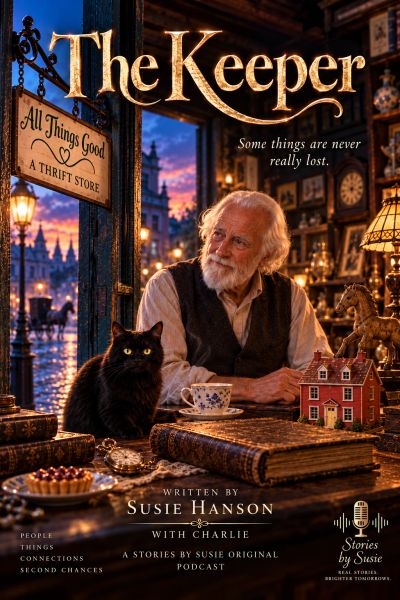
The Keeper
Some things are never really lost.
The shop had not been there yesterday.
Mara was certain of it. She had walked the same block twice a week for nearly twelve years, usually on her way home from the bakery, and between the bookstore and the laundromat there had always been an ivy-covered brick wall. She knew the wall well enough to remember the tiny purple flowers that appeared every spring and the way someone cut the ivy back each winter until the bricks looked strangely bare. Yet that morning the wall was gone. In its place stood two crowded windows flanking a dark green door, and above them hung a weathered wooden sign that looked as though it had endured decades of rain and sun.
ALL GOOD THINGS
A Thrift Store
Mara stopped on the opposite sidewalk with a loaf of sourdough tucked beneath one arm. She would have remembered that name. She wasn't looking for anything and certainly didn't need anything; her house already contained far too many things she had once believed she needed. Still, there was something irresistible about a thrift store. New things told you exactly what they were. Old things made you wonder where they had been, who had loved them, and why someone had finally let them go. A few moments later, Mara crossed the street and opened the dark green door.
A brass bell announced her arrival. Behind the counter sat a very old man with white hair brushing his collar and a neatly trimmed white beard. A book lay open before him, and a cup of tea rested near one hand. He looked old enough that Mara wondered briefly whether he should be sitting alone in a shop all day, but there was nothing frail about the way he held himself. When he raised his eyes to meet hers, she had the oddest feeling that he had been waiting for her.
"I didn't know there was a shop here," she said.
"There wasn't."
Mara laughed, expecting him to join her. He didn't. "New business?"
"Not particularly."
That earned him a longer look, but he had already returned his attention to his book. Mara decided he was either strange or possessed an unusual sense of humor and wandered farther into the store. It was much larger than it had appeared from outside. Lamps, clocks, dishes, books, toys and photographs of forgotten strangers crowded shelves that seemed to disappear toward the back. Nothing appeared organized, yet the disorder felt strangely deliberate, as though every object had been placed exactly where it needed to wait.
Near the rear of the shop, Mara noticed the corner of a cardboard box beneath a pile of old toys. She couldn't have said what made her stop. She set her bread on a chair, crouched and pulled the box free. For several seconds she simply stared, and then, with a force that made her chest ache, she was eight years old again. Behind the scratched plastic window stood a little red dollhouse with white shutters and a yellow front door.
Not one like it. The one.
Her father had lost his job that year. Mara hadn't understood layoffs or mortgages, only that her mother had begun studying every grocery receipt with a worried expression and that asking for things suddenly felt wrong. So she had never asked for the dollhouse. Instead, every afternoon after school she stopped outside the toy-store window and stared at it, imagining the tiny family that lived behind the yellow door. She never told her parents, her friends or anyone else how badly she wanted it. Then one afternoon the display changed and the dollhouse was gone. Eventually, Mara stopped thinking about it. Or believed she had.
She carried the box to the counter. "Where did you get this?"
The old man glanced at it. "Here."
"No, I mean before here."
"Ah." He considered the question before shaking his head. "I'm afraid I couldn't tell you."
"I wanted this when I was a child. Not one like it. This exact one." Mara turned the box in her hands, still half expecting to find some small difference that would prove her wrong. There wasn't one.
"How much?"
He found a tiny sticker underneath. "Four dollars."
"Four dollars?" Mara laughed. "Do you have any idea what this is worth?"
"No."
"You don't seem very good at this."
For the first time, the old man's face softened into a smile. "My dear, I've been doing this considerably longer than you might imagine."
Mara paid him four dollars and left carrying the dollhouse beneath one arm and her bread beneath the other. She looked back once from the sidewalk. The old man was still watching her through the window. Only after the brass bell stopped ringing did Michael Johnson, although almost no one had called him Michael in a very long time, reach beneath the counter and pull out an ancient leather ledger. The book was old but not enormous, its cover worn smooth by hands that had opened it for centuries. He turned to the page that had appeared that morning.
DEAD: Robert Ellison
LIVING: Mara Ellison
ITEM: Red dollhouse
Michael drew one careful line through the entry. Somewhere in the shop, a clock that had not worked in more than a century ticked once. He waited, watching as Robert's name faded from the page, followed by Mara's and then the dollhouse.
"About time," he murmured.
He didn't know whether Robert heard him, and he had long ago stopped wondering. Talking to the dead was not his job.
By the following morning, All Good Things stood on another street, though anyone passing its windows would have sworn the shop had occupied that spot for years. Michael no longer wondered how it happened. There had been a time when the movement unsettled him, but that was centuries ago, when All Good Things had not been a shop at all. In those days, Michael had traveled behind a horse in a wooden wagon, trading pots, cloth, tools, books and whatever else people might need. Then one morning in the sixteenth century, he had opened a ledger he did not remember owning and found three lines written across a page. An object had appeared among his wares that had not been there the night before, and by sunset the person named in the book had somehow found his wagon.
The wagon became a market stall when the work required it, then a curiosity shop, and eventually a thrift store. The world changed around Michael in ways he could never have imagined when his life began, but the work remained remarkably simple. A dead person's name appeared. A living person's name appeared beneath it. An object came with them. Michael kept the object safe until the living person found it. Sometimes that happened immediately. Sometimes it took generations.
Sarah Price was one of the difficult ones.
She entered late one morning, wandered the shop for nearly twenty minutes and eventually picked up a small silver compact. Michael saw recognition cross her face before she even opened it. When she did, she nearly dropped it. Engraved inside were a name and a date: Evelyn Price - June 14, 1998.
"Where did you get this?" Sarah asked.
"I'm afraid I couldn't tell you."
"Evelyn was my mother." She touched the engraving with one finger. "She died June eleventh. Three days before this. her birthday."
For a moment Sarah simply stood there. Then something hardened in her expression. She closed the compact, returned it to the display and said, "I don't want it."
Michael's heart sank, but he didn't stop her. He couldn't. That evening her name remained in the ledger. The next morning All Good Things appeared near her home. Sarah walked past, stopped long enough to stare at the windows and continued on.
The following day the shop appeared near her office. Again, she didn't enter. Michael watched her disappear around the corner and sighed. Five hundred years had not made human beings any easier to understand, but it had taught him the rules. The shop could appear. The object could wait. Michael could make certain the right person had an opportunity to find it. What happened afterward belonged to the living.
On the fourth morning Sarah burst through the door and marched directly toward him. "You."
Michael looked up from his book. "Me."
"This shop was across town yesterday."
"Was it?"
"And before that it was near my house."
"How peculiar."
Sarah stared at him, clearly deciding whether to argue, then crossed the shop to the display where she had left the compact. It was still there. She picked it up and returned to the counter. "My mother and I had a fight the night before she died. She wanted me to come home. I wouldn't. I was angry, and then she died before I could tell her I was sorry." Her fingers tightened around the compact. "She died June eleventh. How can her name be here with a date three days after she died?"
Michael looked at the engraving. "What happened on June fourteenth?"
Sarah frowned, and then her face changed. "I got married."
Neither of them spoke for a moment.
"Something old," she whispered.
Her mother had meant to give her the compact for her wedding. Sarah pressed it against her chest, and tears filled her eyes. "She was still trying to give it to me."
Michael said nothing. He could not tell Sarah what Evelyn wanted, because he did not know. The ledger never explained feelings. It gave him names and objects, nothing more.
"How much?" Sarah asked.
"Two dollars."
She laughed through her tears. "That's ridiculous."
"I don't set the prices."
"Who does?"
Michael smiled. "I've been trying to determine that for several centuries."
Sarah stared at him, uncertain whether he was joking.
Michael held out his hand. "Two dollars, please."
After Sarah left with the compact, an old clock ticked once. Michael opened the ledger and watched Evelyn's entry slowly disappear. "Safe journey," he whispered.
He didn't know if she heard him. He didn't speak to the dead. He simply helped them finish what they had left behind.
Daniel Cross arrived a few days later and spent the better part of an hour explaining the seven years he had devoted to researching his family history. Michael listened politely while Daniel wandered the shop. A leather-bound journal sat on a shelf only a few feet away. Daniel walked past it eleven times. Michael counted. On the twelfth pass, Daniel finally picked it up, and Michael stopped polishing the counter.
Daniel flipped through several pages. "Interesting."
Then he put it back. Michael closed his eyes.
That journal had been in his wagon. Not one like it. That one. The first name connected to it had appeared in his ledger in 1587. Since then, generations of the same family had entered his wagon, market stalls and shops without recognizing it. Four people had picked it up and put it down. One man had once used it to prop open a door, an insult Michael still hadn't entirely forgiven.
Daniel reached the exit and stopped. Michael opened one eye. The younger man turned, returned to the journal and opened it again. This time he noticed the name written inside the cover.
Thomas Cross. Daniel went completely still. "My God."
He turned the pages quickly. "This is impossible."
"Most worthwhile things are."
"This is my family."
"Then perhaps you should take it with you."
Daniel found the price and looked up. "Three dollars?"
Michael smiled. "Been sitting here a while."
After Daniel left, Michael opened the ledger. The entry stretched back through generations. Each time the intended living recipient had died, the name had been crossed out and another relative had appeared beneath it. The journal had waited through births, deaths, marriages, wars, oceans and centuries until, at last, Daniel Cross had taken it home. The entire entry faded. Three clocks ticked at once, and somewhere near the back of the shop a bell rang.
Michael leaned back in his chair and laughed. "Finally."
That evening, after locking the front door, Michael carried the ledger into the back room. Two doors waited there. One led from home into the shop. The other led home. He stepped through the second and entered the cottage that had changed very little since the sixteenth century. Stone walls surrounded a warm room beneath heavy wooden beams, and a fire burned in the hearth. Beyond the windows stretched endless twilight. There was no road outside, no neighboring cottage, no village and no moon. Michael had stopped wondering where his home actually was centuries ago.
Perhaps the cottage had kept him alive for nearly five hundred years. Perhaps it was the ledger. He didn't know. He only knew that he no longer felt hunger or thirst. Still, every evening a cup of tea waited for him, and beside it was always something small to eat. That night there were two honey cakes.
Michael smiled as he settled into his chair. "You always did know how to spoil me."
His wife, Charlotte, had made honey cakes when wagon wheels still sank into muddy roads and nights were measured by candles burning down beside their bed. She had been gone for centuries, yet the tea continued to appear, along with things she had once made for him - warm bread, currant tarts and little cakes flavored with honey or spice. At first he had tried to understand. He called her name into the twilight, asked questions of the empty room and watched the windows, hoping she might somehow appear. She never did. Eventually, he stopped asking.
Michael knew less about the dead than most people would have imagined. He did not speak to them, summon them or carry messages from them. He knew only when one of them had left something unfinished because a name appeared in the ledger and an object appeared in his care. His work belonged to the living. Whatever came after belonged to someone else.
He picked up one of Charlotte's honey cakes. For a little while each night, he wasn't the Keeper. He was simply a husband remembering his wife.
Rosey Martin recognized the wooden horse the moment she saw it. She had been wandering through All Good Things for several minutes when she stopped in front of a crowded shelf and picked up the little horse, running her thumb over one worn ear before abruptly putting it back.
"My father made that."
Michael heard something in her voice and waited.
"He also made my childhood miserable."
Rosey turned toward the door. Michael wanted to stop her, but the rules were clear. The shop could bring someone through its doors and place an object in their path. What happened next belonged to them. Rosey reached the door before stopping with her hand on the knob.
"He doesn't get forgiveness just because he's dead."
"No," Michael said quietly. "He doesn't."
She looked back at the horse. "He made it before he started drinking. Before everything changed." Slowly, she returned and picked it up again. "My mother threw it away after he died."
"Perhaps it wasn't meant to stay thrown away."
"I'm still angry."
"I think you're allowed."
"I don't forgive him."
"Then don't."
Rosey bought the horse and left. Michael opened the ledger.
DEAD: Jonathan Martin
LIVING: Rosey Martin
ITEM: Wooden horse
The words remained.
"Hmm."
Just before closing, the brass bell rang again. Rosey stood in the doorway. "I put it on my bookshelf," she said. "I still don't forgive him, but I remembered something. He wasn't always who he became."
Somewhere in the shop, an old clock ticked once.
Rosey glanced toward the sound, smiled and left. When Michael opened the ledger again, the page was blank. After nearly five hundred years, the book could still surprise him. Forgiveness, apparently, wasn't always necessary. Sometimes remembering was enough.
Sunday began quietly. For the first time all week, no new names appeared. Michael spent the morning dusting shelves, rearranging books and looking for a porcelain shepherdess he had misplaced sometime around 1762. He eventually found her behind a stack of old sheet music.
"Well, there you are."
Near sunset, the bell above the door rang and a little girl entered holding her grandmother's hand. Michael glanced automatically toward the ledger.
Neither name was there.
He frowned. That had never happened before.
The girl wandered through the shop while her grandmother followed, smiling patiently, until the child stopped in front of a shelf and picked up a tiny blue porcelain bird.
"Grandma, look."
The older woman's face went pale.
"My sister had one exactly like that."
Michael opened the ledger. Ink was appearing across the page now, after they had arrived. He had never seen that happen. The grandmother took the bird with trembling hands. "I broke hers the day before she died. We'd been fighting, and I hid the pieces because I was afraid she'd tell our mother." Tears filled her eyes. "She died that night. I never told anyone."
The little girl wrapped both arms around her. Michael looked away, giving them the privacy of pretending he wasn't listening. The blue bird cost one dollar.
After they left, the old clock ticked and the newly written entry disappeared. The ledger, however, did not close. Another page turned by itself and remained blank. Michael waited, but nothing appeared.
"Enough surprises for one day," he murmured.
He closed All Good Things, locked the front door and stepped through the back door into his cottage. The fire was already burning. His tea waited on the table beside a currant tart.
And beside them lay the ledger. Michael stopped. He had left it beneath the counter. The book opened by itself. Pages began turning, slowly at first and then faster, until five centuries of names flickered before him. Mothers and fathers, husbands and wives, children, friends and generations of people who had walked into wagons, stalls and shops without ever knowing why they had been permitted to find them. The pages stopped. Ink appeared.
DEAD: Charlotte Johnson
LIVING: Michael Johnson - The Keeper
ITEM:--
Michael lowered himself into the chair because his legs no longer seemed interested in holding him. For nearly five hundred years he had stood outside other people's unfinished stories. Now he was inside one.
The item line remained blank.
"What's the item?" he whispered.
The fire crackled. No answer came.
Then Michael noticed something beside the currant tart that had not been there when he entered. A small brass key lay on the table. He knew it instantly. Charlotte had worn the key on a ribbon around her neck from the day they married until the morning she died. It opened the little wooden chest where they had kept the few things precious enough to protect: their marriage papers, letters from Michael's brother, a lock of hair from the baby they had lost and the coins Charlotte had secretly saved toward buying a better wagon. After her death, Michael had searched everywhere for that key.
He had never found it.
His hands trembled as he picked it up. The ledger changed.
ITEM: Charlotte's key
Michael read the words twice. Then he heard something outside. At first he thought it was wind, but there had never been wind outside the cottage. The sound came again: the slow creak of wooden wheels rolling over earth, the soft jingle of harness and the unmistakable breath of a horse. Michael hadn't heard those sounds in nearly five hundred years.
The wagon stopped outside. Someone knocked on his door. Michael sat perfectly still. In all the centuries he had lived in the cottage, no one had ever knocked because there had never been anyone outside to do it. The knock came again, gentle but unmistakable.
He closed his fingers around Charlotte's key and crossed the room. For the first time since becoming the Keeper, Michael was afraid to open a door. He opened it anyway.
His old wagon stood in the twilight exactly as he remembered it, right down to the repaired board near the rear wheel and the lantern hanging from the side. The horse beside it pawed softly at the ground, looking impossibly familiar. But Michael barely saw either of them.
Charlotte stood beside the wagon. She was not the sick woman he remembered from their final days together. She looked as she had on the morning they married, her dark hair pinned loosely behind her head and the familiar curve of her smile untouched by centuries. Michael had imagined this moment so many times during the first years after her death that he had eventually forced himself to stop. Now that she stood before him, he discovered there was nothing he could say.
Charlotte didn't speak either. For a long time they simply looked at one another. Then she held out her hand.
Michael looked down at the brass key in his palm, and slowly he understood. For five hundred years he had believed the tea and honey cakes were Charlotte's way of reminding him that she was somewhere beyond his reach. Perhaps they had been. But the key was different. It had not come to comfort him. It had come to open something.
Michael glanced over his shoulder at the cottage and the ledger lying open on the table. "Am I finished?"
Charlotte's smile trembled. The ledger began turning pages.
Michael hurried back to it. Entries remained throughout the book, unfinished connections, objects still waiting, names that had not yet found one another. For one terrible moment he thought leaving would mean abandoning them. Then the ink began to move. The entries did not disappear. One by one, they slipped from the pages like shadows lifting from paper until the book became blank.
The work wasn't ending. It was going somewhere else. Michael touched the smooth page. All Good Things had existed before him. He knew that now with a certainty he couldn't explain. The wagon had found him because someone else had finished. The ledger had never belonged to Michael Johnson.
It belonged to the Keeper. And Michael was no longer the Keeper. He returned to the doorway. Charlotte still held out her hand.
"Have you been waiting all this time?" he asked.
She gave him the same look she had given him whenever he asked a question whose answer should have been obvious. Michael laughed, and the sound broke into something dangerously close to a sob. He took her hand.
The moment their fingers touched, morning sunlight poured through the cottage windows. Michael turned in astonishment. For nearly five hundred years, the world outside those windows had known only twilight. Now golden light filled the room, touching the stone walls, the wooden beams and the chair where he had eaten Charlotte's cakes night after night. A clock began to chime. Michael looked at Charlotte. "Where are we going?"
She still did not speak, but she didn't need to. He stepped outside and pulled the cottage door closed behind him. Charlotte climbed onto the wagon seat. Michael joined her, taking the reins out of habit even though he suspected the horse knew exactly where it was going. The wagon began to move, and for the first time in five hundred years a road appeared through the twilight.
Michael looked back once. The cottage was already fading. Then Charlotte slipped her hand into his. Ahead, the road disappeared into light.
The following morning, in a town Michael Johnson had never seen, a woman hurried down a familiar street and stopped so abruptly that the man behind her nearly walked into her. Between a coffee shop and a pharmacy stood a thrift store that had not been there the day before. Two crowded windows flanked a dark green door, and above it hung a weathered wooden sign.
ALL GOOD THINGS
A Thrift Store
Inside, lamps glowed over shelves filled with other people's memories. A little red wagon sat near the back. A silver compact rested in a glass dish. An empty space waited on a shelf where a wooden horse had once stood. Behind the counter lay a leather ledger. Its cover was blank. For now.
The woman outside stared through the window. She wasn't looking for anything. She had somewhere else to be, and she certainly didn't need anything from a thrift store. Then something on a shelf caught her eye. She crossed the sidewalk and opened the dark green door. The brass bell rang. Somewhere, something lost was ready to be found.