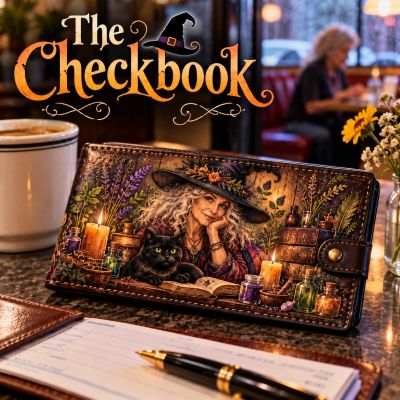
The Haunted Checkbook
Payment is requested.....
Maggie hadn’t gone into the little antique shop looking for anything in particular. That was usually when she spent money. The hand-painted sign in the window read, COME IN. EVERYTHING HAS A STORY. Inside, the shop smelled faintly of cedar, dust, and something floral she couldn’t place. Maggie wandered past chipped teacups, tarnished silver, old picture frames, and shelves crowded with things no one had needed for decades. Then she saw the checkbook cover. It was dark blue, soft from age, and decorated with the silhouette of a witch beneath a full moon. But when Maggie looked closer, the witch wasn’t frightening at all. She had long silver hair and green eyes, and she sat among candles, herbs, tiny bottles, books, and a black cat. There was something peaceful about her. Familiar, almost. A small tag tied to the cover said $3.00.
“Her name was Evelyn,” the shopkeeper said from behind the counter. Maggie looked up. “The witch?” The woman smiled. “At least, that’s what I was told.” Maggie turned the cover over in her hands. “Was she real?” The shopkeeper’s smile faded just a little. “No. Not really.” It was an odd answer, but Maggie bought it anyway. Three dollars for something that made her smile seemed like a bargain. She slipped her checkbook inside, tucked it into her purse, and forgot about it until lunch.
At Rosie’s Diner, the card machine was down again. Rosie’s machine was ancient and seemed to fail whenever it felt like it, which was exactly why Maggie still carried checks. She ordered lunch, ate half of it, and reached into her purse to pay. When she opened the new cover, she froze. The first blank check was no longer blank. In neat handwriting she did not recognize were the words: PAY TO THE ORDER OF: The woman sitting alone at the diner. AMOUNT: One conversation. Maggie stared at it, then looked around the room. Across the diner, an elderly woman sat alone in a booth with a cup of coffee cooling between her hands. She was looking directly at Maggie. Watching her.
Maggie closed the checkbook. She opened it again. The words were still there. “No,” she whispered. She was not walking across a restaurant because a haunted checkbook told her to. That was ridiculous. She signaled Rosie for the bill, paid for lunch, stuffed the checkbook back into her purse, and stood. Then she made the mistake of looking toward the woman again. The woman had turned toward the window. There was something about the slope of her shoulders that stopped Maggie halfway to the door.
She walked over. “Hi. Do you mind if I sit for a minute?” The woman looked surprised, then smiled. “I’d like that.” Her name was Dorothy. Her husband, Frank, had died the year before. For thirty-seven years, the two of them had eaten at Rosie’s every Tuesday. “I still come,” Dorothy said, looking down at her coffee. “I just haven’t figured out how to stop.” Maggie stayed. They talked about Frank, about the diner, about the way grief could turn ordinary places into monuments. Maggie didn’t say anything profound. She mostly listened. When she finally stood to leave, Dorothy hugged her. “Thank you,” she whispered. “I needed someone today.”
Back in her car, Maggie pulled out the checkbook. The writing was gone. The check was blank again. But something on the cover had changed. One of the tiny painted candles beside Evelyn was burning. Maggie touched it. The little flame was warm. She nearly dropped the checkbook. That night, she left it on the kitchen table and tried very hard not to look at it. Before bed, she gave in. A new check waited for her. PAY TO THE ORDER OF: Your sister. AMOUNT: One phone call. Maggie’s stomach tightened. She had not spoken to Elizabeth in three years.
Three years since their mother’s funeral. Three years since an argument that had begun over something small and ended with Elizabeth walking out. Three years of birthdays acknowledged with silence, holidays spent separately, and a hundred almost-phone-calls that never happened. Maggie stared at the check until the words blurred. “You’re asking too much,” she told the woman painted on the cover. Evelyn, of course, said nothing. Maggie found Elizabeth’s number anyway. Her thumb hovered over it for a long time before she pressed Call.
“Maggie?” Elizabeth answered. Maggie swallowed. “Hi.” Silence. Then Elizabeth asked, “Are you okay?” “I’m fine. I just… I thought I should call.” Another silence, softer this time. Elizabeth exhaled. “I’ve picked up the phone a hundred times.” Maggie closed her eyes. “So have I.” They didn’t apologize that night. They didn’t talk about their mother’s funeral or decide who had been right. They talked for twenty-three minutes about work, a neighbor Elizabeth couldn’t stand, a recipe their mother used to make, and absolutely nothing important. When they hung up, Maggie cried anyway.
The check had gone blank. Beside Evelyn, tiny purple flowers had appeared, blooming around the painted books. Maggie brushed one with the tip of her finger and jerked her hand back. The petals were real. Before she could decide whether to laugh or scream, ink began spreading across the next blank check. PAY TO THE ORDER OF: The man you hurt. AMOUNT: The truth.
Maggie knew immediately who it meant. John. Eight years earlier, he had loved her enough to talk about marriage, houses, children, and forever. Then Maggie had been offered a job in another city, and instead of admitting that the future terrified her, she ran. She told John she didn’t love him anymore because that seemed easier than telling him she loved him so much she was afraid of everything that came next. She had let him believe the lie. “I can’t fix that now,” she said. The candle beside Evelyn flickered. Maggie glared at it. “Oh, stop it.” The flame went out.
She found John online. He looked older, happy, and very much as though he had built a life without her. Maggie nearly closed the page. Instead, she wrote: I owe you an apology. I told you I left because I didn’t love you anymore. That wasn’t true. I loved you enough that the future scared me, and instead of telling you, I ran. You deserved the truth then. I’m sorry it took me eight years to give it to you. Her finger hovered over Send. Then she pressed it.
John replied that evening. Thank you. I spent a long time wondering what I did wrong. A second message came a moment later. I’m glad you finally told me. Maggie sat very still. There was no reunion. No declaration that he had waited for her. No magical undoing of eight years. Just the truth, finally delivered to the person who had deserved it all along. The check went blank. On the cover, the extinguished candle relit itself. Maggie smiled—until she noticed Evelyn. For the first time, the silver-haired woman looked sad. “Why?” Maggie whispered. Ink appeared on the next check. PAY TO THE ORDER OF: Maggie. AMOUNT: Forgiveness.
That one made her angry. Maggie had understood Dorothy. She had understood Elizabeth and John. But forgiveness for herself felt like cheating. She had left John with a lie. She had lost three years with Elizabeth because neither of them had been willing to bend. She could list a dozen chances fear had made her miss and twice as many mistakes she still carried like proof of who she was. “No,” she said. “Some things you don’t just forgive.” A soft thump came from the kitchen.
A black cat was sitting beside the checkbook. Maggie stared at the back door. It was closed. She looked at the cat again. Yellow-green eyes stared back. A tiny white patch marked its chin, and around its neck was a purple collar with a silver tag. SABRINA. Maggie slowly turned toward the checkbook cover. The painted black cat beside Evelyn was gone. “You have got to be kidding me.” Sabrina lifted one paw and placed it directly on the check.
Maggie sat down. “What exactly am I supposed to do with that?” Sabrina blinked. Maggie looked at her own name. She thought of all the years she had spent replaying mistakes after everyone else had moved on. “I don’t know if I can forgive myself,” she said quietly. Sabrina’s paw remained on the paper. “But maybe I can stop punishing myself.” The word PAID appeared across the check. Maggie sucked in a breath. On the cover, Evelyn smiled. Then the books beside her shifted, revealing a tiny painted address and two words beneath it: Find Evelyn.
The address led Maggie to an abandoned cottage at the edge of town. Sabrina had insisted on coming—or at least Maggie assumed that was what the yowling, door-scratching, and refusal to leave the passenger seat meant. Stranger still, the cat seemed to know the way. When Maggie pulled up in front of the weathered house, Sabrina was already standing at the window, tail twitching. Purple flowers grew along the broken porch steps. The same flowers that had appeared on the checkbook cover.
Inside, dust covered nearly everything. Sabrina slipped through a half-open doorway and began scratching at an old wooden box shoved beneath a cabinet. Maggie pulled it free. Inside were photographs, newspaper clippings, letters, and receipts yellowed with age. One photograph stopped her cold. It was dated 1978. Evelyn stood in front of the cottage, older than Maggie had imagined but unmistakable—silver hair, bright eyes, the same calm face painted on the checkbook cover. In her arms was a black cat with yellow-green eyes and a white spot beneath its chin.
“Sabrina,” Maggie whispered. The cat sat beside her as though this were all perfectly ordinary. The papers told the rest of Evelyn’s story. Some people had called her a witch. She knew herbs, lived alone, took in stray animals, and seemed to know when someone was hurting before they said a word. But the letters told a different story. Evelyn had quietly paid electric bills for families who were struggling. She had sat beside dying people so they would not be alone. She left groceries on porches, cared for abandoned animals, slipped money into envelopes, and helped neighbors who sometimes never knew where the help had come from. And when she died, people moved on. The cottage emptied. The stories faded.
“Everyone forgot her,” Maggie said. Sabrina placed one paw on Maggie’s hand.
When they returned home, Maggie looked at the checkbook and felt her chest tighten. Evelyn’s painted figure had become almost transparent. The candles were gone. The purple flowers were fading. A final check waited inside. PAY TO THE ORDER OF: Evelyn. AMOUNT: Remember me. Sabrina sat beside the checkbook, staring at the fading woman. Maggie finally understood. Evelyn had never been asking for money. She had been asking Maggie to notice people. To listen. To tell the truth. To forgive. And now she was asking for one last thing—not to disappear.
So Maggie told Evelyn’s story. She told Elizabeth first. Then Dorothy at Rosie’s. She showed the photograph to the antique-shop owner. She posted what she had learned, and other people began adding their own pieces. Someone remembered that Evelyn had brought soup when his father was sick. Someone else remembered a woman who always left food behind the church. An elderly neighbor remembered the strange silver-haired woman who took in every unwanted cat in town. One memory became five, then twenty. Evelyn had not been forgotten after all. She had only been waiting for someone to start the remembering.
That night, Maggie opened the checkbook. Across the final check shimmered one word: PAID. On the cover, Evelyn smiled. Then, slowly, she disappeared. The chair remained. The books remained. The moon, the branches, and the little cottage remained. But Evelyn was gone.
Weeks passed. Maggie kept the checkbook, although no more messages appeared. Sabrina stayed too, which Maggie suspected had never really been up for discussion. One Tuesday, Maggie was back at Rosie’s when she noticed a young mother counting bills at a nearby table while two children shared a plate of fries. Maggie didn’t wait for a check. She caught Rosie’s eye, nodded toward the table, and quietly paid their bill.
When Maggie got home, Sabrina was sitting beside the checkbook. “What?” Maggie asked. Sabrina tapped it with one paw. Maggie opened the cover. For the first time in weeks, words had appeared. Not on a check this time, but faintly along the inside edge of the cover: ACCOUNT BALANCED.
Maggie laughed. Sabrina looked past her toward the empty painted chair. For just a second, the cat’s ears lifted and her eyes followed something Maggie couldn’t see. Maggie glanced at the cover. She could have sworn Evelyn was sitting there again, smiling. Then the chair was empty.
“Come on, witch cat,” Maggie said. Sabrina purred. Somewhere in the quiet room, a tiny bell rang.
THE END
© 2026 Susan (Susie) Hanson. All rights reserved. This story may not be copied, reproduced, or distributed without written permission. This is an original work of fiction.